
The Apostle Matrix. The Most Important Customer Framework Most Businesses Hardly Use.
In 1995, two Harvard Business School researchers published a paper that should have changed how every business thinks about its customers.
Thirty years later, most businesses are still measuring customer satisfaction and calling it customer loyalty — as though the two are the same thing.
They are not. And the gap between them is where revenue quietly disappears, brands are damaged without anyone noticing, and the customers a business worked hardest to acquire become its most enthusiastic critics.
The Matrix
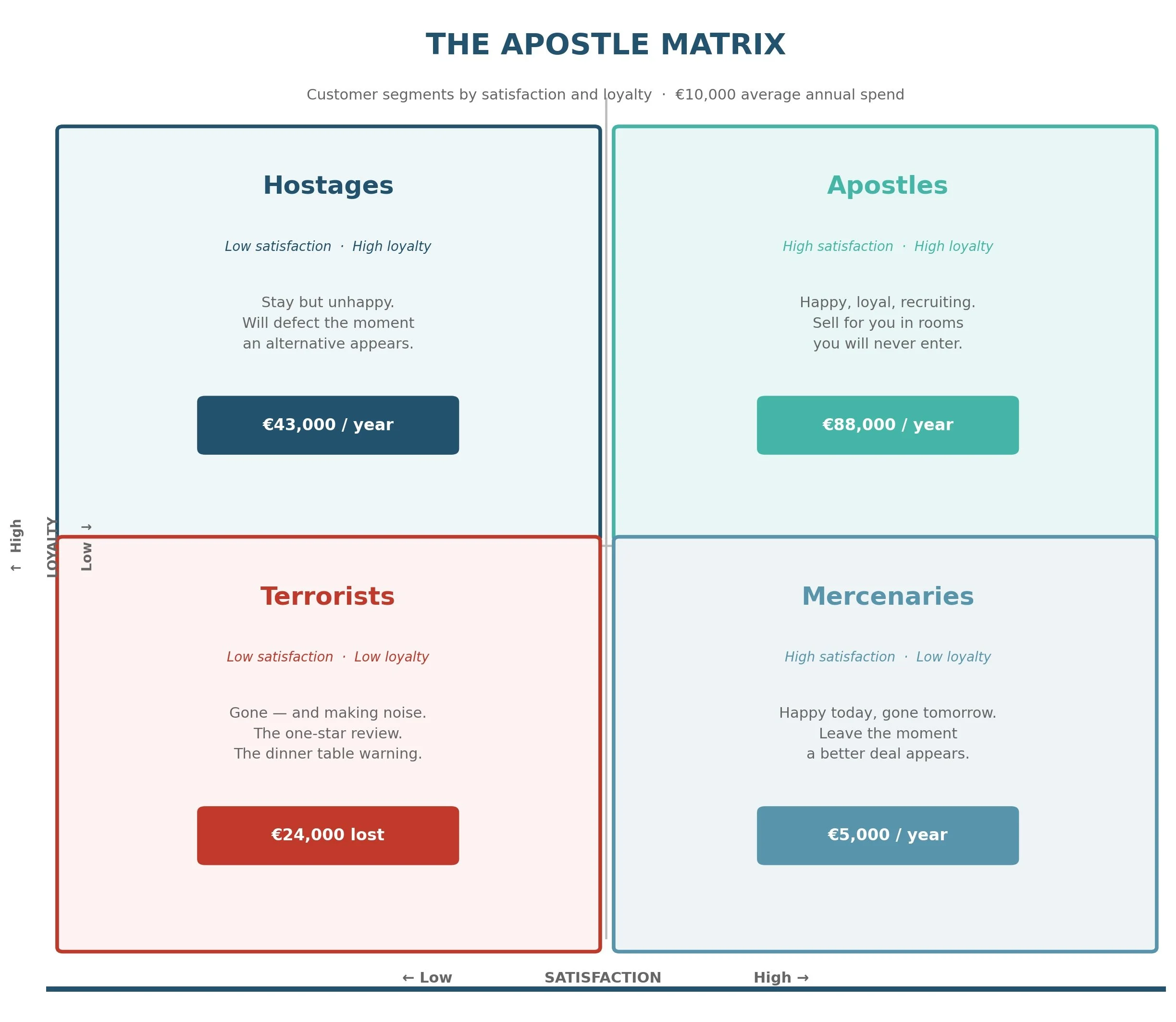
The Apostle Model maps every customer on two axes. Satisfaction — how happy they are with the product or service. Loyalty — how likely they are to stay, return, and recommend.
Most businesses measure only the first. The second is where the commercial reality actually lives.
Plot those two axes and four customer segments emerge — each one requiring a completely different response, a completely different investment, and a completely different communications strategy.
The Apostles — High Satisfaction. High Loyalty.
These are the customers every business is trying to create, and almost none are deliberately investing in.
The Apostle does not just stay. They recruit. They recommend unprompted, in conversations the brand will never hear, to people whose trust in the recommendation is significantly higher than their trust in any advertising the brand could ever produce. They absorb service failures without defecting because the accumulated experience of the relationship is strong enough to absorb the occasional disappointment.
An Apostle is worth multiples of their own revenue in the customers they bring with them — and multiples again in the customers they quietly steer away from competitors.
The commercial question every business should be asking is how many Apostles do we have? What are we deliberately doing to create more of them? Are we investing in that creation with the same discipline that we apply to acquiring new customers who may never become Apostles at all?
The Hostages — Low Satisfaction. High Loyalty.
The Hostage stays. Not because they want to. Because they have no viable alternative, because switching costs are prohibitive, or because the market structure gives them nowhere else to go.
“I have encountered Hostages at scale in every mass consumer and business organisation I have worked in, customers who were deeply dissatisfied, loudly resentful, and completely trapped. The organisation interpreted their continued presence as loyalty. It was not loyalty. It was captivity.” Steve Gardiner
And captivity has an expiry date.
The moment regulation opens the market, the moment a competitor enters, the moment the switching cost drops below the level of accumulated frustration — the Hostage leaves. Not gradually. In a wave. Taking every conversation they have had about the brand with them and converting it, overnight, into the most damaging category on the matrix.
The Hostage who is liberated does not become a satisfied customer of the competitor. They become terrorists for the brand that held them.
The Mercenaries — High Satisfaction. Low Loyalty.
The Mercenary is happy. They enjoy the product, appreciate the service, and have no specific complaint. They will also leave the moment someone offers them a better deal.
Mercenaries are the customers that acquisition-focused marketing produces in abundance and retention-focused strategy struggles with entirely. They respond to offers. They churn when the offer expires. They return when a better offer is presented. They are expensive to acquire, retain, and generate no organic growth through advocacy.
The mistake most businesses make with Mercenaries is treating them as a retention success when they accept a discount to stay. They have not been retained. They have been temporarily repriced. The underlying loyalty deficit has not changed.
Mercenaries require a fundamentally different approach — not better offers, but the accumulated experience of value that converts satisfaction into genuine commitment. This takes time, consistency, and the kind of customer experience management that most businesses underfund because the results are not visible in the next quarter.
The Terrorists — Low Satisfaction. Low Loyalty.
The name is accurate, and the word detractor does not do the damage justice.
The Terrorist has left — or is leaving — and they are not going quietly. They are the one-star reviews written at midnight with genuine grievances. That LinkedIn post reaches the professional network of everyone who might have been a prospect. The dinner table conversation costs the brand three potential customers who will never appear in any churn report because they never arrived.
Every business has Terrorists. Most businesses are not measuring them. And in the social media environment of 2026, a single motivated Terrorist with a substantial following can produce reputational damage that no marketing budget can fully repair.
The response to a Terrorist is not a customer service script. It is the business understanding that they were once a potential Apostle — that something in the acquisition, onboarding, or exit created this outcome — and that the only commercially rational response is to understand exactly what happened and ensure it does not happen again..
The Matrix as a Management Tool
The Apostle Model is not a satisfaction survey. It is a strategic framework for understanding the true composition of the customer base — and for allocating the defence budget accordingly.
Grow the Apostle segment deliberately. Identify the Hostages before they are liberated. Convert the Mercenaries through experience rather than an offer. And address the conditions that create Terrorists before they are created.
This is true Customer Base Management applied with the precision the framework demands. Not as a theoretical exercise — as a live operational discipline, continuously measured, continuously managed, and continuously connected to the commercial outcomes it directly determines.
“I have applied this framework across some of Europe and the Middle East's largest customer bases. The businesses that understood their Apostle ratio and managed it deliberately outperformed those that measured satisfaction scores and assumed they meant the same thing.” Steve Gardiner
At Lighthouse PR, we help clients understand not just how they communicate with their customers, but which customers they are communicating with, what segment those customers occupy, and what the communications strategy for each segment should be designed to achieve.
Because the message that converts a Mercenary is not the message that deepens an Apostle, and the response that might recover a Terrorist is not the response that creates a Hostage.
The matrix tells you which is which. Everything else follows from knowing the answer.
———
About the Author
Steve Gardiner (exec MBA) is a senior marketing and commercial leader at Lighthouse PR, bringing global experience from Accenture, Electronic Arts, Virgin Media, Telekom, and Etisalat. Latterly, as VP Business at Etisalat, he was responsible for $1.8B in revenue.
Today, Steve applies his strategic, marketing, and growth expertise to support Lighthouse PR clients as part of the agency’s service offering.
About Lighthouse PR
Lighthouse PR is a leading PR agency in Romania that works with a select number of organisations across Central and Southeastern Europe, delivering media relations, reputation management, crisis communications, social media and an extensive range of marketing services — always led by senior practitioners.
We hold exclusive membership for Romania and the Republic of Moldova in both the Eurocom worldwide PR network and the CCNE, Europe's leading crisis communications network.
Lighthouse PR: Clear. Concise. Convincing.